It’s a modest, three-storey structure at Guindy in Chennai, pretty unassuming, with a board outside that says ‘Tamil Nadu Electricity Inspectorate’. So why is it at the heart of an ambitious initiative aimed at rescuing the state from a growing energy crisis?
The answer lies in the arithmetic of supply and consumption. Tamil Nadu produces roughly 7,000 MW, but demand is in the range of 8,000 MW. The shortfall on any given day varies between 750 MW and 1,000 MW and the administration is currently focussed on speeding up projects that will add more supply, albeit at considerable cost to the exchequer and environment. A nuclear power project at Kudankulam (which throws up questions about handling toxic waste) and coal-fired plants in north Chennai (spewing tonnes of carbon emissions) are among the ones being fasttracked. It seems like a difficult tradeoff between our immediate needs and the potential impact of our profligate ways. But there is another option, a much less explored one, and that’s where the Bureau of Energy Efficiency (BEE) at Guindy comes in.
BEE, a statutory body under the Union power ministry, has been studying usage patterns since 2001 when the Energy Conservation Act was passed, and is engaged in formulating a strategy aimed at encouraging efficient use of power by domestic and commercial users.
Oh yes, you already know that. Turn off the water heater, keep the AC’s thermostat at 24 degrees, use fluorescent lights...blah, blah, blah. Well, guess what? All those little gestures that you have been constantly reminded about add up to a whole lot of units saved. In fact, BEE officials say that if industries and domestic consumers across the state make an effort to use electricity efficiently, at least 1,800 MW of power can be saved every month. For a region facing a deficit of 750-1,000 MW, that would be enough to bridge the gap and carry a surplus for the next two years. What’s stopping us then?
To start with, policy initiatives fail to reward judicious use of power or urge users to migrate to energy-friendly technologies. A Tamil Nadu Electricity Board official says obsolete technology, low capacity utilisation and illmaintained machinery are the reasons why industry consumes about 45% of power generated, making it the largest consumer.
But BEE is now in the process of identifying the biggest guzzlers. “According to our survey, there are 54 such industrial organisations in Tamil Nadu,” says the TNEB official. Once all the industries are identified and their consumption and billing patterns reviewed, they would be given deadlines to reduce consumption.
The only hitch though is that industry has little incentive to upgrade to expensive technologies that consume less power. Unlike the West where industries enjoy tax breaks if they migrate to a more energy-friendly process, the government here does not dangle any carrots. The same principle goes for domestic users — Chennaiites running ACs at full blast in their homes enjoy the same tariff as a farmer in Dindigul waiting for the power to bring his pump back to life so he can water the fields. Neither is conservation rewarded nor waste punished.
However, there is some hope now. According to a TNEB official, industries that do not have the monetary capacity to invest in energy-saving devices will soon be aided by BEE through Energy Service Companies (ESCOs). ESCOs will install energysaving equipment for the client and recover the cost from the savings made by the client. Companies investing in such devices would thus save on energy bills, thereby cutting back on expenditure
An AC chiller that makes ice at night and uses the melted ice to cool the air in the morning, reducing consumption by 25%
Solar panels that power pumps used to chill water. This cool water is used by the air-conditioning system
Specially-designed windows at the factory absorb the heat and thereby save energy
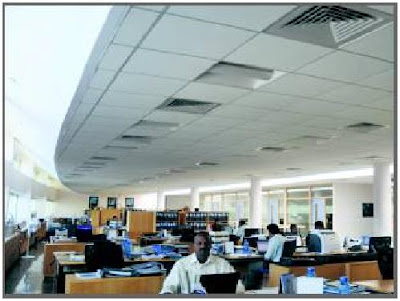 Light enters the Grundfos Pumps office in Thoraipakkam through windows designed to bring in 95% of the sunlight


